

Wind Mitigation Inspection in Panama City: A Homeowner’s Guide to Insurance Savings
Did you know that the windstorm portion of your Florida insurance premium can account for as much as 70% of your total annual bill? For many families in the Panhandle, these skyrocketing costs feel like an unavoidable burden of coastal living. You aren't alone if you feel a sense of anxiety every time a new policy renewal arrives, which is why a professional wind mitigation inspection in Panama City is often the most effective way to regain control over your household budget.
The good news is that your home's structural safety can be transformed into documented insurance currency. This guide explains how the updated OIR-B1-1802 form, which became mandatory in April 2026, serves as your key to unlocking significant premium credits that often range from hundreds to over a thousand dollars each year. We'll explore the specific features that fortify your roof and openings, the differences between various insurance inspections, and the logical steps to take to ensure your agent has the right paperwork to lower your rates immediately. By understanding how these credits work, you can move forward with the confidence that your home is both physically resilient and financially optimized.
Table of Contents
What is a Wind Mitigation Inspection in Panama City?
A windstorm mitigation inspection is a specialized assessment of a property's ability to withstand the extreme pressures of a hurricane. Unlike a typical inspection that looks at the overall condition of a house, this process focuses exclusively on the structural features that prevent wind damage. In our region, a wind mitigation inspection in Panama City is the primary tool homeowners use to prove their property is resilient enough to earn insurance discounts.
Florida law requires insurance companies to provide premium credits for homes with documented wind-resistant features. This is a no-risk inspection for the homeowner. The report is used only to identify potential savings; it cannot be used to increase your rates or penalize you for the age of your home. To secure these credits, we provide you with the OIR-B1-1802 form. The current version, mandatory since April 2026, requires detailed photographic evidence and permit verification for every feature we inspect. It's the essential document your agent needs to update your policy.
Why Panama City Homeowners Need This Now
The memory of Hurricane Michael remains a significant factor in how local insurance is priced. Since that event, the focus on the Florida Building Code has intensified across Bay County. Because the windstorm portion of a premium can account for up to 70% of a homeowner's total insurance cost, these inspections serve as a financial shield. Whether your home was built under the stricter post-2001 codes or has been recently retrofitted, documenting those safety features is the only way to ensure you aren't overpaying for coverage.
Wind Mitigation vs. Standard Home Inspections
It's common to confuse this service with a standard home inspection, but the objectives are very different. A standard inspection evaluates functional systems like plumbing and electrical to find defects. In contrast, a wind mitigation inspection in Panama City targets specific structural points of failure. We look at how your roof is attached to the walls and how your windows are protected. This targeted approach allows the inspection to be completed efficiently, typically in under an hour, while providing the exact data your insurance carrier requires.
Focus: Structural integrity and wind resistance rather than general maintenance or cosmetic issues.
Documentation: Uses the specialized OIR-B1-1802 form instead of a general property condition report.
Validity: A wind mitigation report remains valid for five years, provided no material changes are made to the structure, such as a roof replacement.
The 7 Key Categories of the Florida Wind Mitigation Report
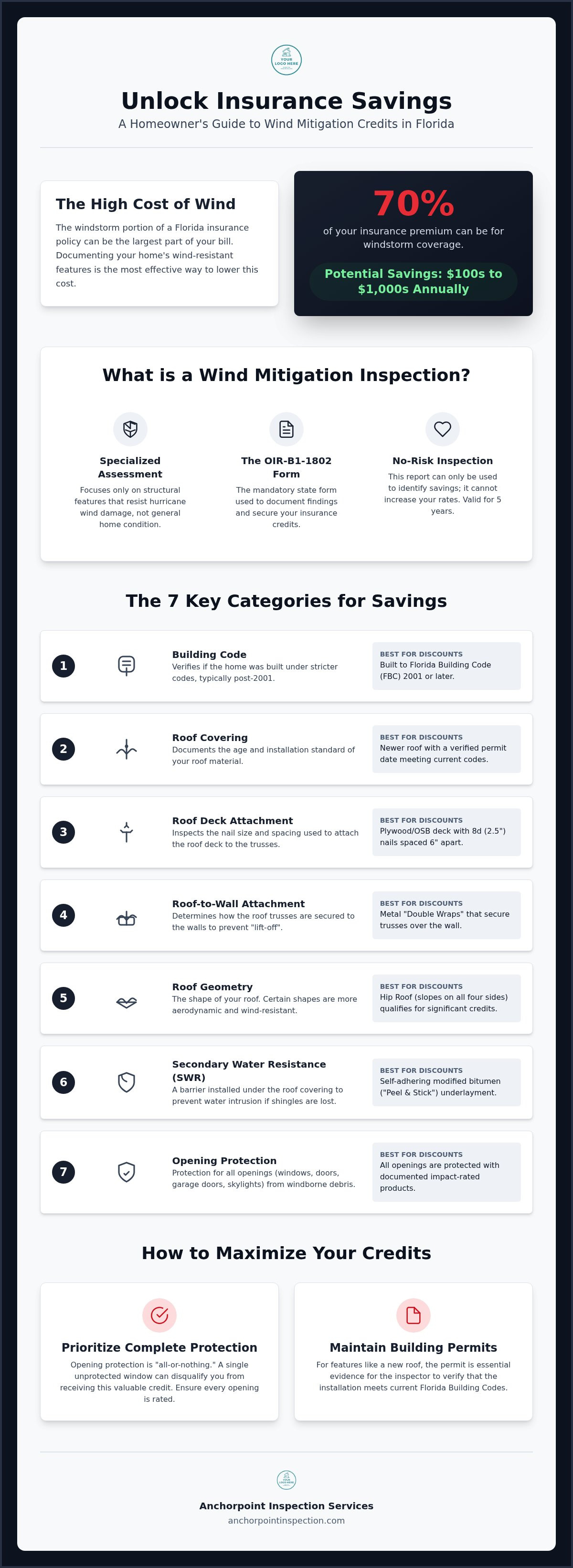
During a wind mitigation inspection in Panama City, we follow the standardized OIR-B1-1802 form to evaluate specific structural categories that determine your home's resilience. Each area we inspect represents a potential credit on your insurance policy's declaration page. Because insurance carriers are strictly regulated, we must provide clear photographic evidence for every feature we document. These photos prove to your agent that your home meets the rigorous standards set by Florida's wind mitigation requirements.
Secondary Water Resistance is a crucial barrier against roof leaks during high winds. This feature, along with the others listed below, serves as a verified asset in the eyes of your insurance carrier, moving you closer to the maximum available discounts.
Roofing: Age, Geometry, and Decking
The roof covering is often the most significant factor in your report. We verify the permit application date to ensure the installation meets current safety standards. Beyond age, we look at roof geometry. Hip roofs, which slope on all sides like a pyramid, are much more resistant to wind lift than gable roofs and almost always trigger a discount. We also examine the roof deck attachment, specifically looking for nail size and spacing. We're looking for nails that are at least 2.5 inches long and spaced every 6 inches on the edges, which is a standard known as the "6 and 12" rule. If you aren't sure about your roof's specifications, you can book a professional walkthrough to identify these features.
Structural Connections and Opening Protection
How your roof connects to your walls is vital for preventing "roof blow-off" during a storm. During a wind mitigation inspection in Panama City, we check for metal clips or single/double wraps that tie the rafters to the wall structure. These are far more secure than older "toenail" methods used in previous decades. We also look for Secondary Water Resistance (SWR), which typically involves a self-adhering polymer modified-bitumen underlayment. This sticky layer seals the seams of your roof deck even if the shingles are blown away. Finally, we evaluate opening protection. This includes impact-rated windows, glass doors, and garage doors. It's important to remember that opening protection is usually an all-or-nothing credit; every single opening must be protected to qualify for the full discount.
Wind Mitigation vs. 4-Point Inspection: Which Do You Need?
Homeowners often find themselves confused by the various types of reports required by insurance carriers. While a wind mitigation inspection in Panama City focuses on the structural strength of your home, a 4-point inspection evaluates the overall health and age of your property's vital systems. You can think of wind mitigation as an assessment of how your home fights against a storm, while a 4-point inspection determines if the home is likely to suffer a claim from internal failure.
In many cases, Panama City residents benefit most from bundling these services. A favorable wind mitigation report lowers your premium, but a clean 4-point report is often what allows you to secure a policy in the first place. Carriers frequently demand both to get a complete picture of the risk they're assuming. Combining these evaluations into a single visit is a practical way to satisfy Florida insurance inspection requirements without scheduling multiple appointments.
The 4-Point Standard for Older Florida Homes
If your home is over 20 years old, most insurers will require a 4-point inspection to verify the condition of the HVAC, electrical, plumbing, and roofing systems. Carriers view older homes as higher risks for non-wind claims, such as fire or water damage. During this walkthrough, we look for specific "red flag" items that could lead to a coverage denial. Common issues that result in a failed report include outdated polybutylene plumbing or Federal Pacific Electric (FPE) panels, which are known fire hazards.
It's helpful to understand the different outcomes of these two reports. A clean 4-point report makes your home "insurable" by proving the systems are well-maintained and safe. A wind mitigation inspection in Panama City makes that insurance "discountable" by proving the structure is resilient. One gets you the policy; the other gets you the savings.
Strategic Inspection Planning
The best time to schedule these inspections is typically during a home purchase or 60 days before your policy renewal date. This timing gives you a window to address any issues found, such as minor roof repairs or updating an old water heater, before they impact your coverage. At Anchorpoint, we streamline this process by performing both evaluations simultaneously. This methodical approach ensures you have all the necessary documentation for your agent in one clear package. We focus on providing the clarity you need to make informed decisions about your home's maintenance and your insurance budget.
How to Maximize Your Windstorm Mitigation Credits
Maximizing your insurance savings requires a proactive approach to documentation. While your home might possess high-quality safety features, an insurance carrier will only grant credits if we can provide objective proof through permits or physical verification. A wind mitigation inspection in Panama City is most effective when the homeowner has already established a clear paper trail. If a roof's age or installation date cannot be verified through official records, it defaults to the least favorable credit tier. This simple lack of data can cost you hundreds of dollars in lost annual savings.
Opening protection is often the most accessible "low-hanging fruit" for significant savings. While the initial investment in hurricane shutters or impact glass can be notable, the ROI is often realized quickly through premium reductions. Because most Florida insurers apply these credits on an all-or-nothing basis, protecting every window and door is the only way to capture the full financial benefit. We recommend checking every opening, including garage doors and skylights, to ensure no single point of failure negates your hard-earned discounts.
Preparing for the Anchorpoint Inspection
Gather your documents before we arrive at your property. This includes roofing permits, impact ratings for windows, and manufacturer specifications for hurricane shutters. We also need clear access to the attic. This is critical because verifying the roof-to-wall connection usually requires a physical look at how the rafters meet the top of the wall. If we can't see the clips or wraps, we can't document them for your credit. You can find your home's "year built" and "roof permit" data by searching the Bay County public records online. Having these details ready ensures your report is as accurate as possible from the start.
Post-Inspection Upgrades
Sometimes, the report reveals areas where your home could be stronger. If your inspection shows "toenails" instead of "clips" for roof-to-wall connections, you might consider a structural retrofit. This upgrade can significantly lower your premium and increase your peace of mind. Similarly, the next time you replace your roof, ensure your contractor adds a Secondary Water Barrier (SWR). This self-adhering layer provides an extra level of protection and triggers a specific credit on the OIR-B1-1802 form. Once upgrades are complete, you can schedule a wind mitigation inspection in Panama City to update your records. Resubmitting a fresh report to your agent is the final step in securing your lower rate and ensuring your policy reflects the true resilience of your home.
Booking Your Panama City Wind Mitigation with Anchorpoint
Selecting the right professional for your wind mitigation inspection in Panama City is about more than just checking boxes on a form. It's about ensuring that every structural detail of your home is accurately documented to maximize your potential savings. At Anchorpoint Inspection Services, John R. Gramlick III brings a deep understanding of Bay County's unique building history and local permit requirements. We don't just hand over a report; we take a diligent, educational approach to help you understand exactly how your home's features protect you and your wallet. This clarity helps lower the anxiety that often comes with rising insurance costs.
Once the walkthrough is complete, you won't be left waiting or wondering about the results. We provide a comprehensive digital report including the official OIR-B1-1802 form, which is the standardized document insurance carriers require. This form translates our technical findings into the specific language your insurance agent needs to apply your premium credits. Your next step is simply to forward this digital file to your insurance carrier. Most homeowners see these credits applied at their next renewal, though some carriers may process the reduction even sooner. We're here to answer any questions your agent might have, ensuring a smooth transition from the inspection to your actual savings.
Our Service Area and Expertise
We've spent years serving the entire Bay County region, from the coastal properties of Panama City Beach and Mexico Beach to the established residential neighborhoods in Lynn Haven. Each area has its own set of challenges, whether it's salt-air exposure on the coast or different building permit cycles inland. Our experience covers everything from high-rise condos to single-family homes, and we tailor our approach to the specific age and style of your property. For homeowners with outdoor amenities, we also provide a specialized pool inspection Lynn Haven FL to ensure every part of your property is safe and well-maintained.
Schedule Your Inspection Today
We understand that insurance deadlines are often tight and policy renewals wait for no one. Our booking process is designed to be efficient and transparent, ensuring you get the documentation you need before your policy renewal date. We take pride in being a stabilizing presence during what can be a confusing time for many Florida homeowners. By choosing a wind mitigation inspection in Panama City with Anchorpoint, you're partnering with a diligent mentor who is invested in your home's long-term well-being and financial health. We prioritize accuracy and clear communication so you can move forward with total confidence.
Securing Your Home's Future and Your Financial Peace of Mind
A professional wind mitigation inspection in Panama City is one of the most effective tools available to lower your annual insurance costs while ensuring your property is ready for storm season. By documenting structural features like roof-to-wall connections and impact protection on the standardized OIR-B1-1802 form, you provide your insurance agent with the verified evidence needed to apply significant premium credits. This process isn't just about raw data; it's about making informed decisions that protect your family and your long-term investment.
As a Florida Licensed Home Inspector (#HI15309) with deep local expertise, John R. Gramlick III is committed to providing the accuracy and supportive guidance your insurance carrier requires. We focus on transparency and education, ensuring you understand every credit your home earns. We invite you to Schedule Your Wind Mitigation Inspection with Anchorpoint to begin the process of optimizing your policy and reducing your premiums. Taking this proactive step ensures you aren't overpaying for coverage while gaining a clear, expert perspective on your property's structural resilience. We look forward to helping you fortify both your home and your budget.
Frequently Asked Questions
How much can I actually save with a wind mitigation inspection in Panama City?
Savings vary based on your home's specific features, but most Florida homeowners see annual premium reductions between $100 and over $1,000. Because the windstorm portion of a Florida insurance policy can account for up to 70% of the total cost, even minor credits for roof geometry or window protection make a difference. A wind mitigation inspection in Panama City often pays for itself within the first year through these insurance savings.
Does a wind mitigation report expire in Florida?
A wind mitigation report is valid for five years from the date of the inspection in the state of Florida. However, this validity remains only if no material changes are made to the structure. If you replace your roof or install new impact-rated windows before the five years are up, you should schedule a new inspection to ensure your policy reflects the most recent safety upgrades and maximum available credits.
Will my insurance premium go up if the inspection finds weaknesses?
No, your insurance premium won't increase if the inspection identifies structural weaknesses. This is a no-risk assessment designed specifically to identify credits and discounts. If your home lacks certain wind-resistant features, you simply won't receive those specific credits. The report serves as a baseline for your current safety features and won't be used by carriers to penalize you or raise your existing rates for the home.
What is the OIR-B1-1802 form, and why do I need it?
The OIR-B1-1802 is the standardized Florida Office of Insurance Regulation form used by inspectors to document a home's wind-resistant features. The current version, mandatory as of April 2026, requires detailed photos and permit verification for categories like roof-to-wall connections and deck attachments. You need this specific form because it's the only document insurance agents are authorized to use when applying windstorm mitigation credits to your policy.
Can I perform my own wind mitigation inspection?
No, you cannot perform your own wind mitigation inspection for insurance purposes. Florida law requires these inspections to be completed by a qualified professional, such as a licensed home inspector, a certified building code inspector, or a licensed contractor. At Anchorpoint, we provide the necessary credentials and expertise to ensure your report is accepted by all Florida insurance carriers, which a self-performed assessment would not achieve.
What is the difference between a roof certification and a wind mitigation report?
A roof certification verifies the current condition and estimated remaining life of your roof, often required for older homes to prove insurability. In contrast, a wind mitigation report focuses on how the roof and openings are built to withstand high winds. While a roof certification proves your roof isn't failing, a wind mitigation inspection in Panama City provides the data needed to trigger specific premium discounts based on structural strength.
How long does a professional wind mitigation inspection take to complete?
A professional wind mitigation inspection typically takes between 30 and 60 minutes to complete at your property. During this time, we need access to the exterior of the home and the attic space to verify roof-to-wall connections. Because we follow a methodical, step-by-step process, we can gather all necessary photographic evidence efficiently without causing a significant disruption to your daily schedule or home environment in the Bay County area.
Do I need a wind mitigation inspection for a new construction home in Panama City?
While new construction homes in Panama City are built to stricter Florida Building Codes, you still need a wind mitigation report to receive insurance discounts. Carriers don't automatically apply credits based on the year your home was built. Having a formal wind mitigation inspection in Panama City documented on the OIR-B1-1802 form is the only way to prove your new home meets the specific requirements for secondary water resistance and structural connections.


Comments