

Florida Home Inspector License Verification and Renewal
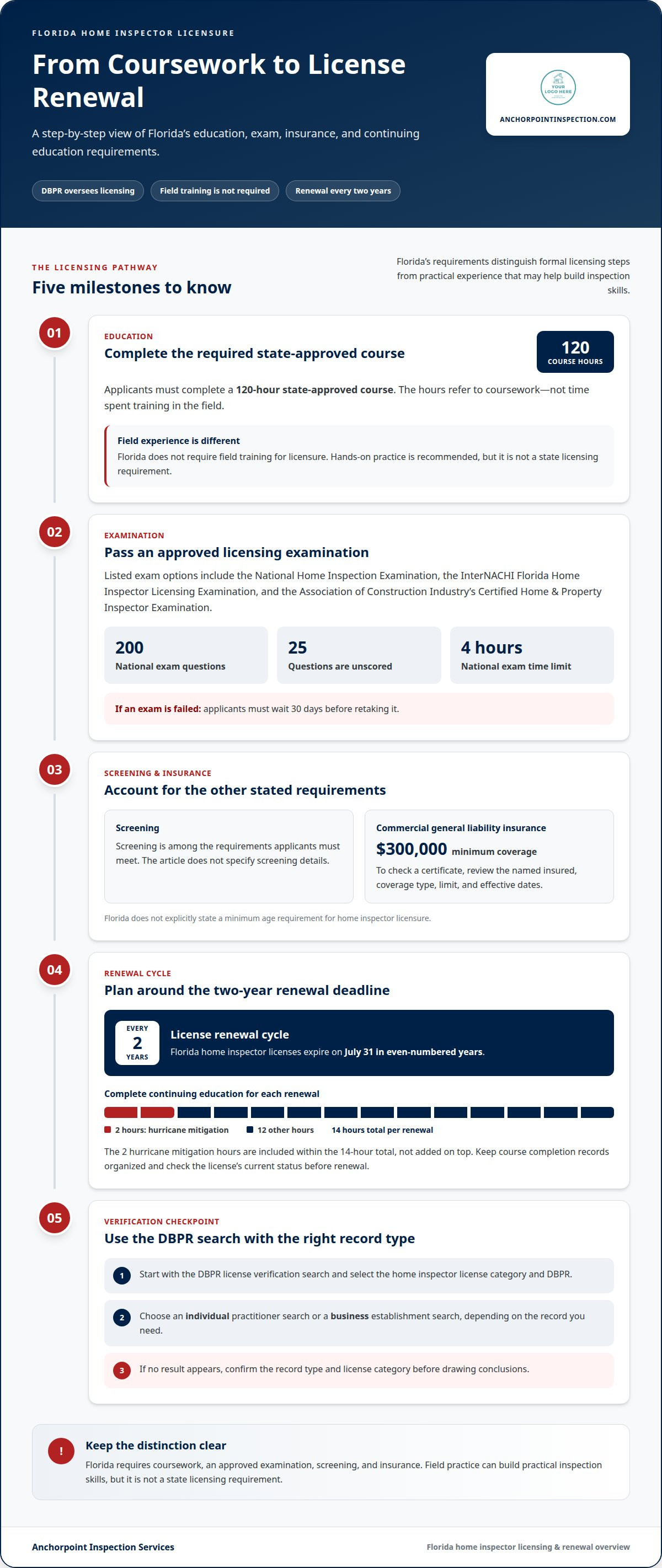
Florida doesn’t require field training for home inspector licensure. Applicants must complete a 120-hour state-approved course, according to the Florida Department of Business and Professional Regulation (DBPR). For home inspector license verification in Florida, use the state’s license search and select the correct license type to check an individual or business.
It’s reasonable to want clarity about both the requirements and the records behind a license search. Field practice can help build inspection skills, but it isn’t a state licensing requirement. Knowing the difference makes it easier to understand what Florida requires and what a search result can tell you.
This guide explains Florida’s licensing and training requirements, renewal cycle, and continuing education rules, plus how to filter a DBPR search. You’ll also learn what a name search may reveal, including other licenses and complaints, and how to interpret those results carefully.
Table of Contents
Florida home inspector licensing requirements
Florida home inspector licensure is state authorization to perform home inspections professionally. The Florida Department of Business and Professional Regulation (DBPR) oversees this license. Applicants must meet education, examination, screening, and insurance requirements. Florida doesn’t explicitly state a minimum age requirement for home inspector licensure.
A state-approved course is required education for applicants. According to the Florida Department of Business and Professional Regulation, Florida requires applicants to complete a 120-hour state-approved course. The course provides foundational knowledge for evaluating residential properties. Its required hours refer to coursework, not time spent training in the field.
An approved examination assesses an applicant’s knowledge before licensure. Florida applicants may take the National Home Inspection Examination, which has 200 multiple-choice questions, including 25 unscored questions, and a four-hour time limit. Other listed options include the InterNACHI Florida Home Inspector Licensing Examination and the Association of Construction Industry’s Certified Home & Property Inspector Examination. Applicants who fail an examination must wait 30 days before retaking it.
Field training means practical experience inspecting properties in person. Florida doesn’t require it for licensure, although hands-on practice is recommended. This distinction helps applicants separate formal licensing steps from useful experience. For example, observing how an inspector documents roof conditions can connect classroom concepts with real property features.
Commercial general liability insurance is coverage for certain claims involving injury or property damage. Florida requires home inspectors to carry at least $300,000 in this coverage. To verify an inspector’s insurance, request a current certificate of insurance and review the named insured, coverage type, limit, and effective dates. These details help establish whether the document matches the inspector and remains current.
Reporting suspected unlicensed activity means submitting relevant information to the state licensing authority. Send a complaint to DBPR with the inspector’s name, business name, property address, and inspection date. Include copies of relevant advertisements, reports, or communications, and keep a record of what you submit. Clear details help identify the person involved and describe the activity being reported.
License renewal cycle and continuing education
A renewal cycle is the period between required license renewals. Florida home inspector licenses must be renewed every two years. Continuing education, or CE, is instruction completed to maintain professional knowledge and meet renewal requirements. Florida requires home inspectors to complete CE to renew their licenses, so renewal involves more than submitting an application.
The expiration date is the deadline by which a license must be renewed. Florida home inspector licenses expire on July 31 every two years in even-numbered years. That fixed date gives inspectors a clear point to plan around. For example, an inspector can map course completion and renewal preparation against the upcoming July 31 deadline.
CE is measured in hours completed during the renewal period. Florida requires 14 hours of continuing education for each license renewal. Those 14 hours include two hours on hurricane mitigation. The requirement combines general learning with a focused topic relevant to Florida homes, where hurricane-related conditions can affect property inspections.
Hurricane mitigation education covers measures that can reduce a home’s vulnerability to hurricane damage. Its two-hour requirement is part of, not additional to, the 14 CE hours. Inspectors can plan their coursework by identifying hurricane mitigation content first, then arranging the remaining hours around other approved learning. Keeping course records together can make renewal preparation more orderly.
A renewal plan is a simple schedule for completing CE before the license expires. Start by noting the applicable July 31 expiration date, then allocate time for all 14 hours, including hurricane mitigation. Avoid leaving the entire requirement until the final weeks; spreading coursework across the two-year cycle can make it easier to manage alongside inspection work. Before renewal, organize completion records and review the license’s current status through the state’s license search. A current record helps distinguish an active license from one approaching its renewal deadline.
Filtering practitioner and establishment searches by profession and board
Practitioner searches look up individual license records, while establishment searches look up business records. Choosing the right record type and license category helps narrow results to the relevant Florida home inspector.
Profession and Board Filters
Profession and board filters narrow a license search to the relevant occupation and licensing authority. Start with the home inspector license category and the Florida Department of Business and Professional Regulation (DBPR), then choose whether to search for an individual or a business. The selection matters because DBPR handles licenses across different occupations. A contractor category, for example, isn’t the right match for an inspector’s license.
Online License Lookup
The online license lookup is DBPR’s official search tool for Florida license records. Use the DBPR license verification page, identify the license type, and follow the link for an individual or business search. This is the official starting point for home inspector license verification in Florida. If no result appears, confirm that you selected the correct record type and license category before drawing conclusions.
Information for License Searches
Search information is the identifying detail used to find a person’s or business’s license record. For a practitioner search, begin with the inspector’s name; for an establishment search, use the business name. A name search may also surface other licenses held by the inspector. If your first attempt returns no result, select the appropriate individual or business option, check the spelling and name format, then search using the relevant license type.
License Status and Disciplinary History
License status describes the standing shown on a license record, while complaint history lists complaints associated with an inspector. Review the record’s status and any displayed complaint information. A name search can show complaints filed against the inspector and other licenses. To check for complaints or disciplinary actions, search the inspector’s name through DBPR and review the available record details. If the results remain empty, try a business-name search or revisit the license-type selection.
How to verify a Florida home inspector license online
Online license verification means checking state records to confirm a license’s status. Florida’s Department of Business and Professional Regulation (DBPR) provides the license verification page for this task. Review the record details to confirm you’ve found the inspector or business you intended to check.
Select the license type. The license type identifies which record category applies to the search. DBPR directs users to identify the type and follow the appropriate link for an individual or business. Choose the practitioner search for a person, or the establishment search for a business.
Enter the identifying name. A name search looks for a person or business record matching the information entered. Use the inspector’s name for an individual search, or the business name for an establishment search. If no result appears, check spelling and confirm you selected the right record category and license type.
Review the matching record. A license record contains details associated with the search result. Compare the listed name and license information with the inspector or business you intended to find. Review the displayed status, and don’t treat a similar name as a confirmed match without checking the identifying details.
Look for related records. A name search can show an inspector’s other licenses and complaints filed against that inspector. Review those entries separately from the home inspector license record. A complaint listing is information to note, not by itself a complete account of its circumstances or outcome.
If your first search returns no result, repeat it using the other appropriate search type, individual or business. Then confirm the profession and license type before concluding that the record is absent. Florida homeowners are responsible for ensuring an intended contractor is appropriately licensed, and DBPR’s search provides a direct way to examine available license records.
The official lookup is the Florida Department of Business and Professional Regulation’s online license verification page.
Anchorpoint Inspection Services: Comprehensive Home Inspection
After reviewing an inspector’s license record, Anchorpoint Inspection Services can help you assess a property’s condition. A license search addresses credentials; a Comprehensive Home Inspection focuses on visible components and conditions in the home, giving you practical information for a purchase or property decision.
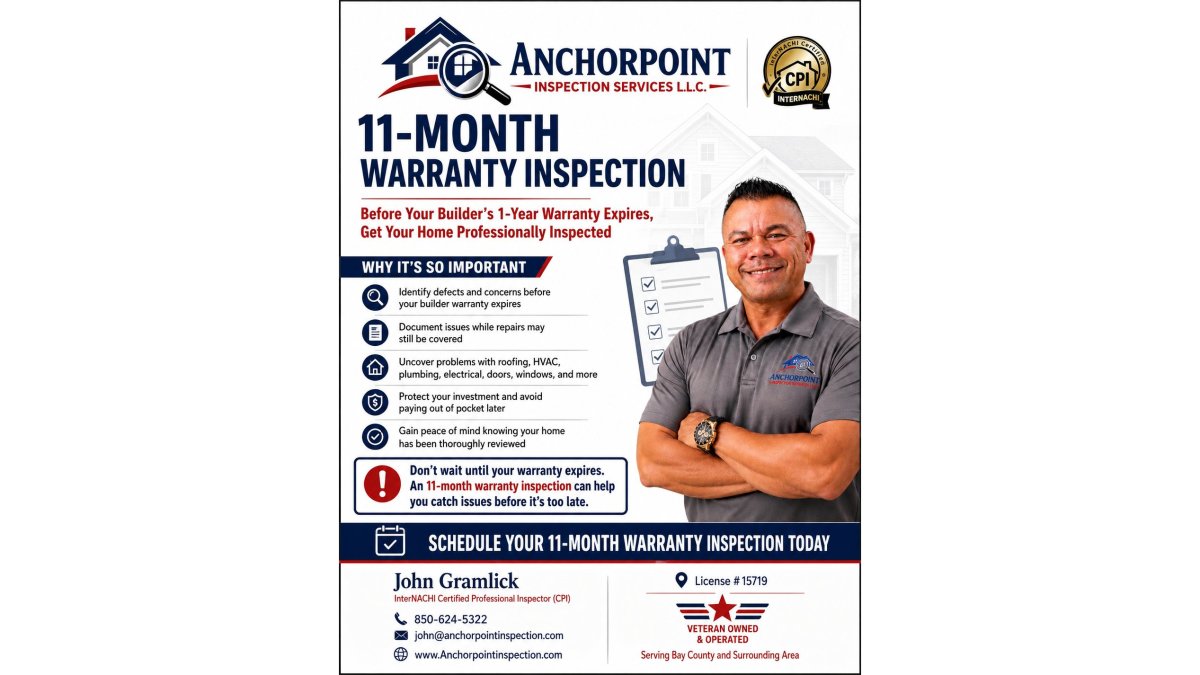
Choose the inspection that fits your situation. A 4-Point Inspection focuses on key areas often relevant to Florida insurance, while a Wind Mitigation Inspection documents features related to wind resistance. An 11 Month Warranty inspection can help identify potential builder defects before a new-home warranty period ends.
An inspection doesn’t replace license verification, and a license record doesn’t reveal a home’s physical condition. Each step serves a different purpose and can contribute to a clearer understanding of the inspector and the property. Contact Anchorpoint Inspection Services to discuss a home inspection for your property.
Make your next property decision with clarity
A license record helps establish who is authorized to inspect, but it can’t tell you the condition of a particular home. Treat credential checks and property evaluations as separate steps: one concerns the inspector’s record, while the other provides observations to consider as you plan a purchase, ownership, or maintenance decision. This distinction keeps home inspector license verification in Florida useful without expecting it to answer questions about a building’s physical condition.
For a closer look at a property, Anchorpoint Inspection Services offers a Comprehensive Home Inspection, Wind Mitigation Inspection, and 4-Point Inspection. The right inspection depends on the property and the information you need. A clear report can help you understand observed conditions and consider practical next steps, alongside the licensing information you’ve reviewed.
When you’re ready to discuss an inspection for your property, contact Anchorpoint Inspection Services. A thoughtful next step can make your property decisions feel more informed and manageable.
Frequently Asked Questions
Does Florida require field training?
No. Florida doesn’t require field training for home inspector licensure, although hands-on practice is recommended. Applicants can build practical familiarity by observing inspections and learning how inspectors document property conditions. For example, seeing how roof observations are recorded can connect classroom learning with an inspection report. Practical experience can support skill development, but it doesn’t replace Florida’s formal licensing requirements.
What are Florida home inspector license requirements and renewal rules?
Applicants need to meet Florida’s education and examination requirements and maintain the license through renewal. The Florida Department of Business and Professional Regulation approves the required 120-hour course. Renewal involves continuing education, including hurricane mitigation instruction, and occurs on Florida’s established renewal cycle. Keep course completion records organized so they’re available when preparing a renewal. A state license search can help distinguish a current record from one needing attention.
Are home inspectors required to be licensed in every Florida county or city?
Florida home inspector licenses are issued through the state licensing system, rather than through separate county-by-county DBPR records. For a statewide credential search, use the Florida Department of Business and Professional Regulation’s license lookup and select the home inspector license type. This lets you search the applicable state record whether the property is in Lynn Haven, Panama City, Panama City Beach, Callaway, Southport, Mexico Beach, Port St. Joe, Santa Rosa, Fort Walton, Niceville, Destin, Pensacola, Gulf Shores, or San Destin.
Comments