

How to Lower Your Homeowners Insurance Premium in Florida: The 2026 Strategy Guide
Did you know that a single wind mitigation inspection can reduce the wind portion of your insurance bill by as much as 45 percent? With the average Florida homeowners policy now reaching approximately $8,200, it is natural to feel a sense of unease every time your renewal notice arrives. You have likely seen your rates climb despite having no recent claims, and the shifting requirements for older roofs or 4-point inspections can feel like a moving target.
The good news is that you have more control over these costs than you might think. This guide provides the most effective, inspection-backed methods to lower homeowners insurance premium Florida residents can use to secure every available credit. We will explore the specific documentation insurers require in 2026, explain how the $10,000 My Safe Florida Home grants are being distributed this cycle, and identify which inspections are mandatory versus those that simply put money back in your pocket. By treating your home as a hardened asset, you can move from a place of uncertainty to a clear, actionable plan for long-term savings.
Table of Contents
Understanding the 2026 Florida Home Insurance Landscape
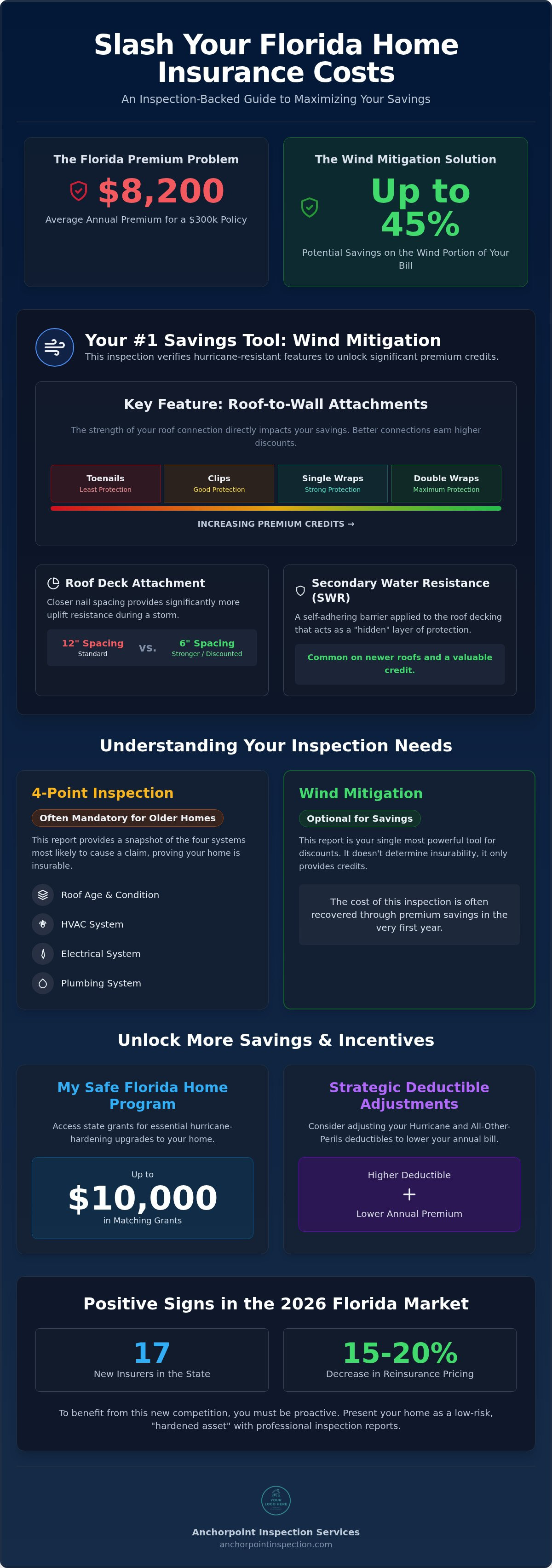
The Florida insurance market is currently in a state of transition. While legislative reforms from 2022 and 2023 have successfully reduced litigation, homeowners in Panama City and Lynn Haven are still finding high totals on their renewal notices. The average premium for $300,000 in coverage now sits around $8,200. This is largely due to a shift toward risk-based pricing. Carriers no longer offer generic rates; they now use granular data to determine exactly how much risk a specific property poses.
If you want to lower homeowners insurance premium Florida costs, you must understand that your home is being viewed as a hardened asset. Carriers are looking for proof of resilience. Since June 2026, reinsurance pricing has decreased by approximately 15 to 20 percent, and seventeen new insurers have entered the state. These are positive signs, but securing a better rate requires you to be proactive with documentation. You have to prove your home is a low risk to benefit from this new competition.
Why Your Renewal Notice is Increasing
Several factors contribute to the rising costs you see in your mailbox. Even as the market stabilizes, the inflationary cost of building materials in the Panhandle keeps repair estimates high. Additionally, carriers are sensitive to the age of a home's infrastructure. If your water heater is over 15 years old or your electrical panel is an outdated brand, you may see automatic surcharges. Carriers use these system ages as proxies for risk, often assuming the worst until an expert provides evidence to the contrary.
The Difference Between Mandatory and Optional Inspections
Understanding which reports you actually need is the first step in managing your costs. A 4 point inspection for home insurance is frequently a mandatory requirement for older homes. It provides a focused snapshot of the four systems most likely to cause a claim:
HVAC: The age and condition of your heating and cooling systems.
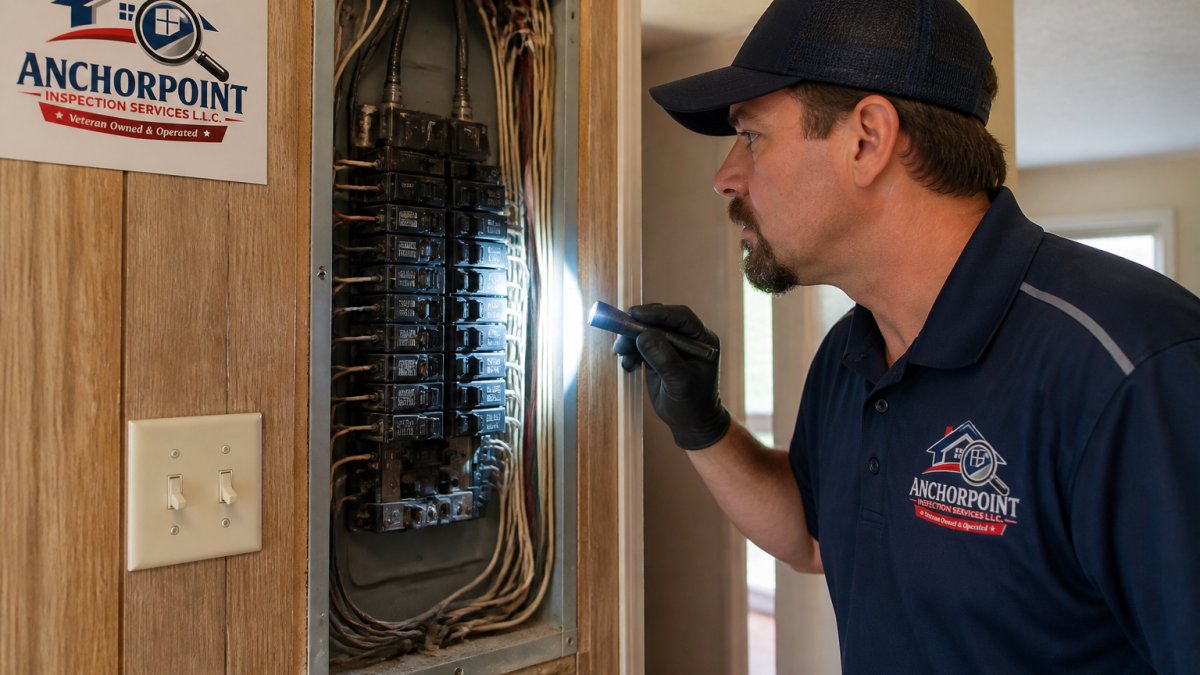
Electrical: Verification of safe wiring and modern panels.
Plumbing: Identification of pipe materials and potential leak points.
Roof: Assessment of the roof's age and remaining useful life.
Without this report, a carrier might refuse to renew your policy entirely. On the other hand, a wind mitigation inspection is generally optional but serves as your most powerful tool for discounts. While a 4-point inspection proves your home is insurable, the wind mitigation report provides the credits that help you lower homeowners insurance premium Florida costs. The return on investment for these reports is clear; the one-time cost of an inspection is often recovered through premium savings in the very first year.
The Power of Wind Mitigation: Your #1 Tool for Premium Credits
A wind mitigation inspection is a specialized assessment that evaluates how well your home can withstand the force of hurricane-strength winds. Because these structural features directly reduce the financial risk to carriers, Florida law requires insurance companies to offer premium credits for positive findings. In 2026, a Wind Mitigation report stands as the single most effective piece of documentation for any homeowner looking to lower homeowners insurance premium Florida costs.
Roof-to-Wall Attachments and Decking
The way your roof is fastened to the walls of your home is one of the most critical factors in your premium calculation. Inspectors look for a specific hierarchy of attachments. Toenails, which are simply nails driven at an angle, offer the least protection and typically no credit. Metal clips provide a stronger connection, while single wraps and double wraps, which physically wrap over the truss and secure it with multiple nails, offer the highest level of safety. Moving from a "toenail" to a "clip" attachment can result in a substantial reduction in your wind premium.
We also evaluate the roof deck attachment, specifically looking at nail spacing. Nails driven every 6 inches into the trusses provide significantly more uplift resistance than those spaced every 12 inches. Another "hidden" discount is Secondary Water Resistance (SWR). This is a self-adhering polymer modified bitumen "sticky" barrier applied directly to the roof decking before the underlayment and shingles. If your roof was replaced recently, you likely have this feature, and documenting it can save you hundreds of dollars annually.
Opening Protection: Windows, Doors, and Garages
When it comes to opening protection, Florida insurers typically follow an "all or nothing" rule. To receive the maximum credit, every single opening in your home, including windows, skylights, and entry doors, must be impact-rated or protected by approved shutters. If even one small window is left unprotected, the carrier may deny the entire credit. The state-run My Safe Florida Home Program is a valuable resource for funding these upgrades, but you must have the proper documentation to prove the work was completed to code.
During a wind mitigation inspection Lynn Haven residents often discover that their garage doors are the weakest link in their home's defense. A wind-load rated garage door is essential for preventing a "blow-out" that could lead to total roof failure. Securing these credits is often as simple as scheduling a wind mitigation inspection to document your home's existing strengths and identify any small gaps that are currently costing you money.
Navigating State Incentives and the My Safe Florida Home Program
The state government has taken active steps to help residents manage the rising costs of coverage. The My Safe Florida Home Program (MSFH) remains one of the most effective ways to lower homeowners insurance premium Florida costs by providing financial assistance for hurricane-hardening improvements. For the 2026-2027 cycle, the state budget approved over $405 million in funding to continue these efforts. This program allows you to identify structural weaknesses through a free inspection and then apply for grants to fix them.
The grant system operates on a matching basis for most households. For every $1 you contribute toward an eligible improvement, the state provides $2, up to a maximum grant of $10,000. Low-income households may receive the full $10,000 without a matching requirement. These funds are specifically designated for upgrades that insurers value most, such as roof-to-wall reinforcements and impact-resistant openings. By using these funds to harden your home, you aren't just protecting your family; you're creating the documented proof carriers need to justify lower rates.
Eligibility and Application Steps for 2026
To qualify for the grant in 2026, your home must meet several criteria. First, the property must have a homestead exemption and be located in Florida. Second, the home must have been built before January 1, 2008. Finally, the dwelling coverage on your insurance policy must be $700,000 or less. The application process typically follows these steps:
Initial Inspection: A state-approved inspector evaluates your home's current wind resistance.
Grant Application: You apply for the matching funds based on the inspector's recommendations.
Contractor Selection: You choose a contractor from the state's approved list to perform the work.
Reimbursement: After a final inspection confirms the work is done, the state provides the grant funds.
Residents in Bay County should be aware that the program often prioritizes low-income or senior homeowners during the initial application windows. Monitoring the official portal for these priority periods is essential for securing your spot in the funding queue.
Comparing State Grants vs. Private Upgrades
While the state program offers significant financial help, the timeline can be lengthy due to high demand. Many homeowners choose to act immediately using private inspections to secure discounts before their next renewal. A private roof certification inspection Florida is often the fastest way to prove a roof's integrity to a carrier that is threatening non-renewal. Additionally, the state has extended the sales tax exemption for home hardening products like impact-resistant doors and windows through June 30, 2029. This allows you to save on material costs even if you aren't waiting for a state grant, providing multiple paths to a more affordable policy.
Strategic Policy Adjustments Beyond Physical Home Upgrades
While hardening your home is a vital part of the process, the way you structure your actual insurance contract plays an equally significant role in your annual costs. Many residents overlook the "soft" credits and policy endorsements that can either save money or lead to massive out-of-pocket expenses later. To effectively lower homeowners insurance premium Florida costs, you must balance your appetite for risk with the technical language in your policy. Bundling your home, auto, and umbrella policies remains one of the fastest ways to trigger a discount, often ranging from 5 to 15 percent depending on the carrier.
In a high-value coastal market like Panama City Beach, a 2% hurricane deductible means a homeowner with $500,000 in dwelling coverage is responsible for the first $10,000 of storm damage before the insurer pays a cent. Understanding this math is essential before you agree to higher deductibles just to shave a few dollars off your monthly bill.
Optimizing Your Deductible Structure
You have two primary deductibles: All-Other-Perils (AOP) and Hurricane. The AOP deductible covers everyday events like a pipe burst or a small kitchen fire. While raising your AOP from $1,000 to $5,000 might seem like a good idea, the actual premium savings are often minimal compared to the increased risk. The real savings usually live in the Hurricane deductible. However, carriers are increasingly pushing "Actual Cash Value" (ACV) roof endorsements on older homes. This means if your roof is damaged, the insurer will subtract years of depreciation from your payout. To avoid this and maintain "Replacement Cost" coverage, providing a professional roof condition inspection for insurance can prove the roof still has a useful life, allowing you to secure much better policy terms.
Credit Monitoring and Claims History
Carriers also look at your "CLUE" report, which is a national database of your claims history. Filing "nuisance claims" for minor repairs that barely exceed your deductible can haunt your premium for years. It is often more cost-effective to handle small maintenance issues out of pocket to keep your record clean. Additionally, modern technology offers new ways to save. Many 2026 policies offer specific discounts for monitored security systems and automatic water shut-off valves. These devices proactively prevent the types of claims that insurers fear most. If you are unsure which policy adjustments are right for your specific property, you can contact a professional inspector to discuss how your home's current condition matches up with common carrier requirements.
Securing Your Savings with Anchorpoint Inspection Services
Anchorpoint Inspection Services understands that a professional report is more than just a collection of data; it is a financial tool designed to protect your investment. In the 2026 market, carriers are looking for any reason to justify higher rates. Accuracy in your 4-Point and Wind Mitigation reports is the primary defense against "premium leakage," which occurs when homeowners miss out on valid credits due to vague or incomplete documentation. By providing the "Gold Standard" of reporting, we ensure that every hurricane-resistant feature of your home is clearly identified and presented in a format that Florida carriers respect. This precision is often the final piece of the puzzle needed to lower homeowners insurance premium Florida costs and secure your policy for the long term.
The Anchorpoint Advantage in Bay County
Our team, led by Florida licensed home inspector John R. Gramlick III, brings deep local expertise to the Panama City and Lynn Haven markets. We understand the specific building challenges unique to the Panhandle, from coastal salt exposure to our region's intense storm history. This local perspective allows us to provide more than just a checklist. For example, our detailed roof certifications can often extend the "insurable life" of your roof by providing carriers with objective evidence of its condition, even if it is approaching the 15-year mark. We view our role as a diligent mentor, offering supportive guidance that lowers the anxiety often associated with the insurance inspection process. We don't just hand you a report; we help you understand how each finding relates to your coverage and your safety.
Next Steps: Booking Your Insurance Savings Audit
Preparing for an inspection doesn't have to be a stressful experience. To ensure the most efficient walkthrough, we recommend scheduling a combined Wind Mitigation and 4-Point inspection. This allows us to cover all the necessary bases for your carrier in a single visit, saving you time and providing a comprehensive view of your home's insurance readiness. You can help the process by having a few key items ready for your inspector:
Roofing Documentation: Copies of permits or receipts for your last roof replacement or major repair.
System Ages: The manufacture dates and maintenance records for your HVAC system and water heater.
Access Points: Ensuring the attic hatch, crawlspace, and electrical panels are clear of obstructions.
By taking these proactive steps, you position yourself to secure the best possible rates in a stabilizing market. Accuracy and detail are your best allies when negotiating with insurers, and having the right documentation in hand makes all the difference. Schedule your inspection with Anchorpoint today to start lowering your premium.
Taking Control of Your Home’s Resilience and Costs
Navigating the Florida insurance market requires a shift from reactive worry to proactive management. By documenting your home's hurricane-hardening features and leveraging state incentives like the My Safe Florida Home grants, you can transform your property into a low-risk asset that carriers are eager to insure. These strategic steps, combined with smart policy adjustments, are the most reliable way to lower homeowners insurance premium Florida residents have at their disposal today.
Accuracy in your reporting is the key to unlocking these savings. As a Florida Licensed Home Inspector (#HI11942) and a proud member of InterNACHI, I provide the precise documentation needed to satisfy the strictest carrier requirements. Our deep local expertise in Lynn Haven and Panama City Beach ensures your home is represented fairly and thoroughly during every walkthrough.
Don't let unpredictable renewal notices dictate your household budget. Request a Professional Insurance Inspection from Anchorpoint today to identify your available credits and start your path toward a more affordable policy. You have the power to protect both your home and your wallet, and we are here to guide you through the process with clarity and confidence.
Frequently Asked Questions
How much can a Wind Mitigation inspection actually save me in Florida?
A wind mitigation inspection can reduce the wind portion of your annual bill by 15% to 45%. Because Florida law requires insurers to provide credits for hurricane-resistant features, this is the most direct way to lower homeowners insurance premium Florida costs. The exact savings depend on your home's construction and your specific carrier's rating system. For many residents in Panama City Beach, the inspection pays for itself within the first year of ownership.
Does a 4-Point inspection guarantee that I will get insurance?
A 4-Point inspection does not guarantee coverage, but it acts as a critical gateway for securing a policy. It provides carriers with a focused snapshot of your HVAC, electrical, plumbing, and roofing systems. If the report identifies outdated components, such as polybutylene piping or an aging electrical panel, the insurer may require repairs before offering a quote. Our role is to provide an accurate assessment so you can address these issues before your renewal deadline.
What is the most important part of a Wind Mitigation report for insurers?
The roof-to-wall connection is often considered the most impactful section of the report for Florida insurers. Moving from basic toenail attachments to metal clips or wraps significantly increases your home's uplift resistance and triggers higher premium credits. Other vital components include the roof deck attachment nail spacing and Secondary Water Resistance. Documenting these structural strengths provides the verified data insurance companies need to justify a lower risk rating for your property.
Can I perform my own wind mitigation inspection for my insurance company?
No, insurance companies require wind mitigation inspections to be performed by a licensed professional, such as a Florida licensed home inspector, engineer, or architect. Reports must be submitted on the official Uniform Mitigation Verification Inspection Form (OIR-B1-1802). Carriers rely on the technical expertise and professional liability of a certified inspector to verify structural features. Attempting to self-document these features will result in the denial of your application for premium credits.
How long is a Florida wind mitigation or 4-Point report valid?
A wind mitigation inspection is generally valid for five years in the eyes of most Florida insurers. However, if you replace your roof or upgrade your windows before that period ends, you should schedule a new inspection to capture the increased credits. For a 4-Point inspection, carriers often request a new report every one to three years for older homes. Keeping these documents current ensures you don't lose your existing discounts during the renewal process.
What happens if my roof is more than 15 years old in Florida?
If your roof is more than 15 years old, your carrier may require a professional roof certification to verify its remaining useful life. While a 2026 law prevents insurers from refusing renewal solely based on age for roofs under 15 years, older roofs are subject to stricter scrutiny. A successful certification proves the roof is still in good condition, helping you avoid being forced into an Actual Cash Value endorsement or a policy non-renewal.
Is the My Safe Florida Home program still accepting applications in 2026?
Yes, the My Safe Florida Home program is currently accepting applications for the 2026-2027 funding cycle. The state legislature approved over $405 million in new funding in June 2026 to help homeowners harden their properties against storms. Applications are typically prioritized for low-income households and seniors first. It is a highly effective way to lower homeowners insurance premium Florida residents can use to fund up to $10,000 in matching grants for home improvements.
Will installing a new garage door really lower my insurance premium?
Installing a wind-load rated garage door can lower your premium if it completes your home's Opening Protection requirements. Insurers often use an all-or-nothing approach for these credits; every window and door must be protected to receive the maximum discount. A reinforced garage door prevents the structural blow-out that often leads to total roof failure during a hurricane. Documenting this upgrade through a wind mitigation report is essential for proving your home's resilience to your carrier.
Comments