

Roof tie down inspection and how it can lower insurance premiums
A roof inspection can influence your homeowners insurance even when there’s no storm damage to report. In Florida, a roof tie-down inspection for insurance credits can document features such as how the roof is attached to the walls, which may help qualify a home for wind mitigation discounts. A wind mitigation inspection may help homeowners qualify for insurance discounts, depending on the features documented and the insurer’s criteria.
It makes sense to want a clear link between a wind-resistant roof and a lower premium. A Wind Mitigation Inspection documents qualifying features in a report for your insurer to review when determining which credits may apply. This article explains roof tie-downs, what the inspection evaluates, how the report relates to insurance credits, and how an insurer’s roof-condition review differs from a wind mitigation inspection. Understanding the difference helps you know what the inspection can document and what may affect your premium.
Table of Contents
How can a safe roof lower the cost of my homeowners insurance?
Documented roof construction and condition can help an insurer assess wind risk and applicable credits. A roof tie-down inspection for insurance credits records roof-to-wall connections. A storm-damage inspection addresses a separate question: whether damage is related to a reported loss.
Inspection Scope and Records
An inspection report records observable roof conditions and relevant construction details. Clear documentation distinguishes wind-mitigation features from damage that may need repair.
A useful roof-condition report identifies the inspection date, property address, roof details, and labeled photographs. For a storm claim, it also records the weather-event date, measurable damage, and the observed cause, including any uncertainty. A repair scope describes the work related to the findings, rather than relying on verbal comments made at the roof.
Give the inspector any prior reports, repair invoices, contractor estimates, and photographs you have. If the inspection relates to a claim, include insurer correspondence and the weather-event date. These records help establish a timeline for comparison with current roof conditions, but an estimate alone does not prove damage.
Roof Condition and Repair History
A professional documents visible roof conditions and distinguishes observed damage from ordinary wear or an uncertain cause. That distinction matters because the reason for a roof problem affects how an insurer evaluates it.
For a reported loss, the record should link each photographed area to a measurable description and the reported weather event. If the inspection cannot determine the cause, the report should say so rather than present an assumption as fact. Clear observations keep repair discussions grounded in evidence.
Keep repair records together, including dates, invoices, estimates, and descriptions of completed work. A contractor’s estimate prices proposed repairs; by itself, it does not establish what failed, when it failed, or why. The insurer’s written scope documents approved claim work, while the policy deductible affects the homeowner’s share of a covered loss. Comparing these records helps show whether proposed repairs match the documented findings.
What an insurance adjuster’s roof inspection covers
An adjuster’s roof inspection evaluates reported damage and documents findings for an insurance coverage decision. A typical on-site inspection takes 30 to 60 minutes, depending on roof size, complexity, and the damage being assessed. The adjuster may photograph affected areas, describe visible damage, and consider whether the evidence fits the reported event. A repair estimate prices proposed work; the inspection report records what failed and the observed cause.
A wind mitigation report serves a different purpose: it records qualifying roof and structural features observed during an inspection. It reflects conditions on the inspection date, rather than setting a universal expiration period. Insurers may require inspections at renewal, so updated documentation can be relevant when roof conditions or policy requirements change. A wind mitigation inspection documents features that may support review for applicable credits.
Roof coverage also depends on the policy’s valuation method. Replacement cost value coverage can pay toward repairing or replacing covered damage at current prices. Actual cash value coverage pays less for an older or worn roof because depreciation affects the amount. When issuing or renewing a policy, insurers may review roof condition and adjust coverage terms. Some may change roof coverage from replacement cost to actual cash value as a roof ages.
In Florida, an insurer may not deny coverage solely because a roof is 15 years old or older if an inspection shows at least 5 years of remaining useful life. That makes the inspection finding important: the report should document condition and remaining useful life rather than relying on age alone. Insurers can also use roof findings to decide whether to continue coverage, reduce it, or require repairs within a specified timeframe. Keep the inspection report and photographs with policy correspondence, so the findings can be understood alongside the coverage decision.
Wind mitigation inspection and insurance credits
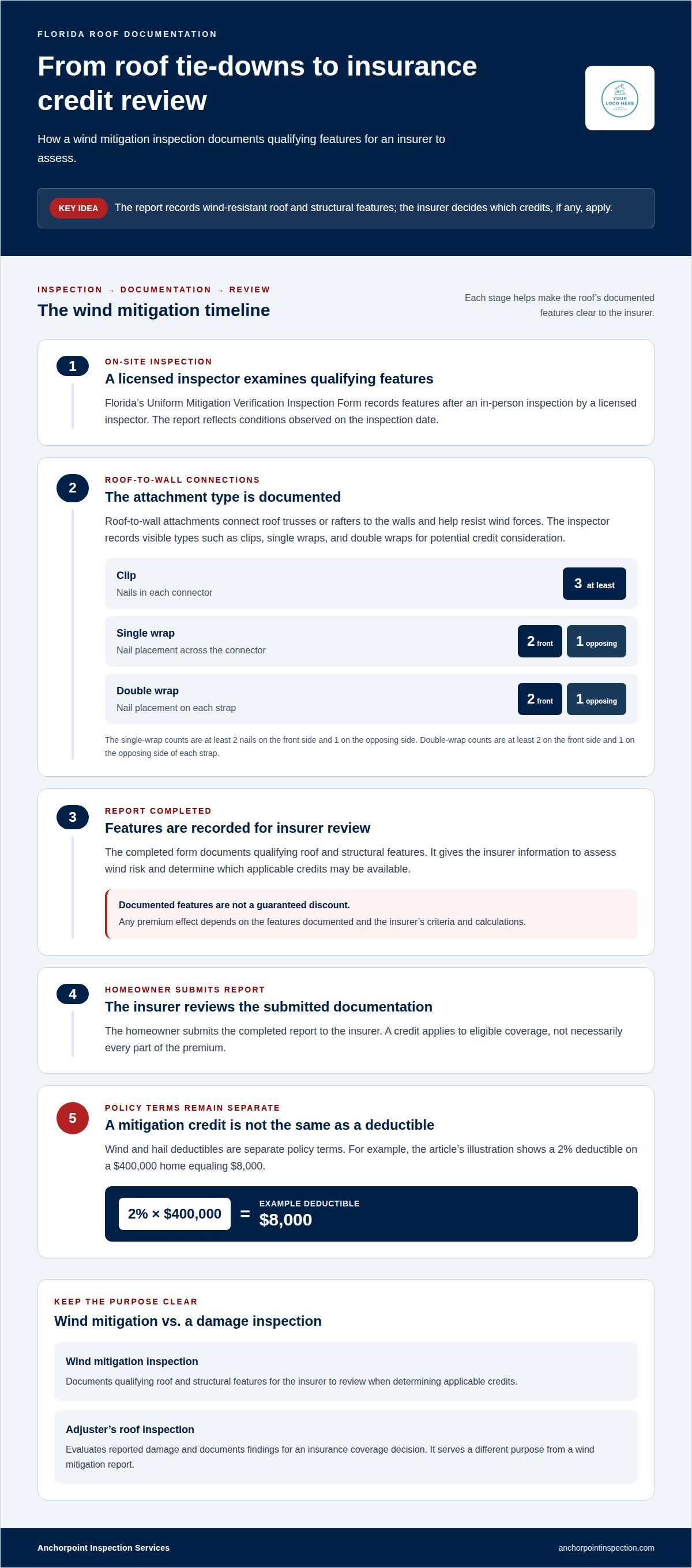
A Wind Mitigation Inspection documents roof features that can affect an insurer’s assessment of wind risk. In Florida, the report records qualifying features for the insurer to review when determining applicable credits.
Wind Mitigation Credits and Discounts
Wind mitigation credits reflect protective features documented during an inspection, helping homeowners understand how roof construction could affect premiums. Wind mitigation features may affect homeowners insurance premiums, depending on documented features and insurer calculations.
Florida’s Uniform Mitigation Verification Inspection Form records these features after an in-person inspection by a licensed inspector. The homeowner submits the completed report to the insurer. A credit applies to eligible coverage, not necessarily every part of the premium. Wind and hail deductibles are separate policy terms: a 2% deductible on a $400,000 home equals $8,000.
Qualifying Roof-to-Wall Attachments
Roof-to-wall attachments connect roof trusses or rafters to the walls and help resist wind forces. An inspector documents attachment types such as clips, single wraps, and double wraps for potential credit consideration.
A clip should have at least 3 nails in each connector. A single-wrap connector requires at least 2 nails on the front side and 1 on the opposing side. Double-wrap connectors require at least 2 nails on the front side and 1 on the opposing side of each strap. The inspector records visible attachment details; the insurer evaluates their credit eligibility.
Documenting Roof Attachments
The Uniform Mitigation Verification Inspection Form records roof-to-wall attachments along with other wind-resistant features. Accurate entries matter because insurers use the submitted report to assess applicable credits.
A roof tie-down inspection for insurance credits is an in-person assessment that documents how the roof connects to the walls. The inspector records the attachment type and supporting observations rather than relying on a homeowner’s description. The report addresses mitigation features, not storm damage such as shingle granule loss. An adjuster evaluates a separate insurance claim, and clear records can help explain findings during a dispute.
Tie-Down Upgrades and Insurance Credits
A roofing professional installs or upgrades tie-downs; an inspector documents the resulting features. The distinction is important: installation changes the roof, while an inspection records what is present for insurance review.
After an upgrade, a new inspection can document the attachments on the form submitted to the insurer. The insurer then decides whether those features qualify for credits under the policy. The material and attachment type matter, but a documented improvement does not automatically change the premium or deductible.
Insurer roof inspections
An insurer’s inspection helps evaluate roof condition when issuing or renewing homeowners coverage. A Wind Mitigation Inspection is different: it documents features that may support insurance credits.
A typical on-site roof inspection for an average single-story home takes 30 to 60 minutes. The inspector examines visible areas, including shingles, flashing, gutters, and roof edges, then records findings with photographs. The review may identify damage, wear, or conditions that need attention. A consistent set of images and written observations gives the carrier a clearer record than a brief verbal summary.
Some insurers require a roof inspection at renewal, not only when a homeowner first applies. Roofs approaching or past 15 to 20 years old are more likely to trigger an inspection requirement. The carrier may use the report to assess condition and decide whether to continue coverage, reduce coverage, or require repairs within a stated timeframe. A roof’s age can prompt scrutiny, but the inspection focuses on observed condition and findings.
After the visit, the homeowner usually receives a roof inspection report or photo set within one to three business days. Read the findings alongside the policy notice: a carrier’s roof-condition review is not the same as an approved storm-claim repair scope. If shingles are damaged, flashing is loose, or gutters show related issues, specific notes and photos should make the observed condition clear. Good records help distinguish maintenance concerns from documented storm damage.
An independent inspection provides a separate record of visible property conditions, while the insurer’s review informs its coverage decision. Keep the report with carrier correspondence, especially if a renewal notice sets a repair deadline. This makes it easier to compare the findings with the carrier’s requested action.
Arrange a home inspection to document property conditions with a professional assessment.
Anchorpoint Inspection Services: Roof Certification
Anchorpoint Inspection Services provides Roof Certification to document a roof’s condition and verify its remaining useful life. This can help when an insurer requests information about roof condition. A Wind Mitigation Inspection documents wind-resistant features for insurance review. The two inspections answer different questions, so choose the report that matches the insurer’s request.
If you need a broader view, a Comprehensive Home Inspection evaluates the home’s overall condition, while a 4-Point Inspection focuses on key systems for insurance purposes. The appropriate inspection depends on the information you need documented, such as roof condition, wind-mitigation features, or major home systems.
Make your next roof decision with clarity
The value of a roof tie-down inspection for insurance credits goes beyond a possible premium adjustment. A clear professional assessment can help you plan maintenance, document your home’s condition, and discuss insurance decisions. Treat the inspection as one part of caring for your property, not simply as a form to submit.
Choose an inspection that matches the decision in front of you. Anchorpoint Inspection Services offers a Comprehensive Home Inspection for an overall property assessment, a Wind Mitigation Inspection for documenting wind-resistant features, and a 4-Point Inspection for key home systems. The right scope helps keep the resulting information focused on your needs.
If you’re ready to discuss the inspection that fits your situation, contact Anchorpoint Inspection Services. A well-informed next step can make roof and insurance decisions feel more manageable.
Frequently Asked Questions
Is paying for an inspection and certification worth it?
An inspection is worthwhile when its report answers a specific insurance or property question. If an insurer requests a roof-condition document, a Roof Certification provides a professional assessment of the roof’s condition and remaining useful life. For potential wind credits, a Wind Mitigation Inspection documents features for insurer review. Compare the report’s contents with your insurer’s request and your policy needs.
What is Wind Mitigation?
Wind mitigation means using and documenting features designed to help a home resist wind damage. An inspection considers more than tie-downs: roof shape, roof-deck attachment, opening protection, and secondary water resistance may also matter. Impact-rated shutters and a sealed roof deck, for example, address different vulnerabilities. The inspection records observed features so the insurer can assess them under its credit criteria.
What documents and photos should I provide for a professional roof tie-down insurance inspection?
Provide the property address, any insurer request, prior inspection reports, and records of roof work. For a storm-related concern, include the event date and any photographs taken soon afterward. Organize images by roof area, such as the front slope, rear slope, and visible attic connections. Repair invoices or contractor estimates can explain changes since earlier documentation, but they do not replace the inspector’s observations.
How do I schedule a professional roof tie-down inspection, and what should I provide to prepare?
Contact Anchorpoint Inspection Services to arrange a Wind Mitigation Inspection. Share the property address and your insurer’s documentation request, along with any prior report or records of roof upgrades, so the inspection can focus on the relevant features. Service is available in Lynn Haven, Panama City, Panama City Beach, Callaway, Southport, Mexico Beach, Port St. Joe, Santa Rosa, Fort Walton, Niceville, Destin, Pensacola, Gulf Shores, and San Destin.
What are the roof tie-down inspection and insurance credit rules in Florida and other states?
Florida uses the Uniform Mitigation Verification Inspection Form to document wind-resistant features for insurer review. Other states do not follow one universal roof tie-down credit rule; eligibility and documentation requirements depend on the state and insurer’s policy criteria. A form or inspection report supports the review, but the insurer determines how documented features affect coverage or credits under the policy.
What happens if a roof tie-down inspection finds inadequate or damaged connections?
The report documents the observed connection and its condition, helping distinguish an installation concern from visible damage. The insurer uses that information to review eligibility or a related claim. If the report identifies a repair concern, keep the finding with your repair records and arrange appropriate work. A follow-up inspection can document the resulting condition and give the insurer updated information to assess.
Comments